
saasups Enterprise Modernization Index 2026
Why most legacy modernization projects stall before the first migration ticket — and the estate-mapping discipline that separates the programs that ship from the ones that don't.
Most enterprise modernization projects don't fail from lack of ambition. They fail from lack of clarity — before the first commit.
By the time a team starts moving workloads, the decisions that matter are already made. Which applications retire. Which get refactored. Which stay where they are. Those calls get made in a workshop, on a whiteboard, from partial knowledge of a system nobody fully understands anymore.
That's the real problem with legacy estates. The dependency map never existed. The cost model was a guess. The architecture diagram was three reorganizations out of date. So the plan was built on assumptions — and assumptions surface as incidents, mid-migration, on a Friday.
The industry's answer has been the six-month consulting engagement. A team arrives, interviews your engineers, and leaves a slide deck with an invoice attached. The deck is a snapshot. Your estate is a living system. By the time the recommendations land, they're already drifting from reality.
Modernization shouldn't start with a guess. It should start with a map.
saasups is not an enterprise-architecture repository, a static code-intelligence scanner, an architectural-observability tool, or a general transformation workbench. Those tell you what you have or how it's built. saasups answers the operational question a modernization program actually turns on: which application gets which treatment, in what order, and what it becomes on AWS.
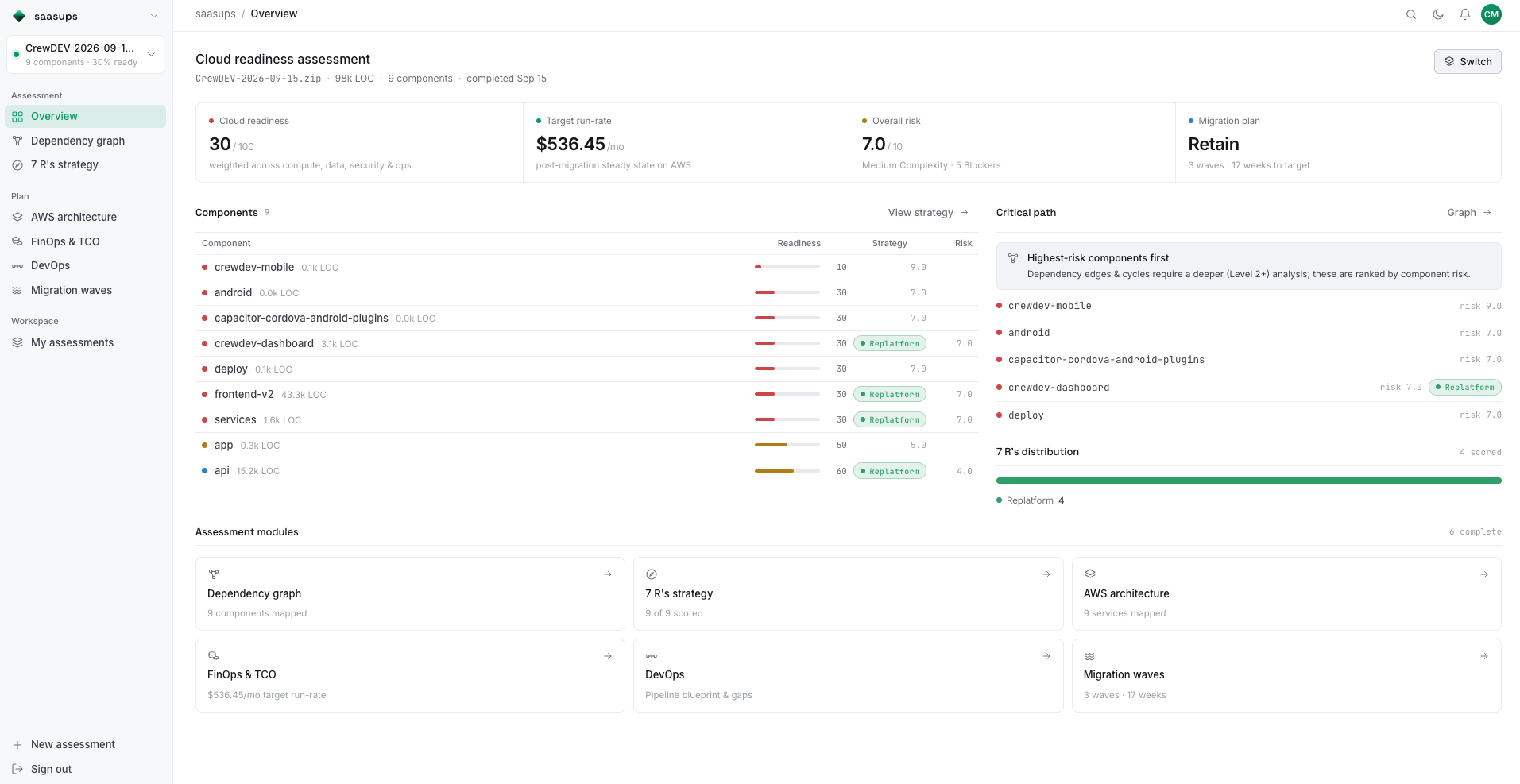
saasups ingests your running systems and traces every dependency — every service call, every database link, every circular reference the documentation never mentioned. It produces a scored estate map, typically in under 24 hours for environments up to 200 applications.
Then it scores each application against all seven modernization strategies — Rehost, Replatform, Refactor, Rearchitect, Rebuild, Replace, Retire — not as opinions a consultant weighs, but as ranked recommendations with the evidence attached.
From there it generates a specific AWS target architecture: landing-zone-aware, with the cost model built in. FinOps is not a dashboard you check after the migration. It is the lens you design through, from the first scored recommendation.
The output is executable, not just presentable. Engineers get implementation-ready pipeline artifacts. The board gets a roadmap it can defend with data. Both trace back to the same source: your actual estate, as it actually runs.
Legacy modernization is genuinely hard — old systems, undocumented dependencies, high stakes on both sides of every decision. We don't pretend it's easy. We make it navigable: the full picture before you commit a single engineer to a workstream.
Why most legacy modernization projects stall before the first migration ticket — and the estate-mapping discipline that separates the programs that ship from the ones that don't.